


Average Doesn't Work
Large-Capacity Shop Important to Growth of Future Vision Partnership
A dozen years ago, Vaughn Zacharias farmed 1,800 acres. He was selling seed, too. Vaughn figures the money he made from the seed business was likely "lost" on the farm. That was the story year after year. The farm worked, but it lacked forward momentum.
"We were tired of being average," Vaughn says. The Zacharias grain farm, now named Future Vision Partnership, resides outside Kathryn, N.D., and no longer claims "averageness." Look for the farm on Google Maps, and the name Future Vision pops up, as do the small towns around it.
"We are considerably larger," says Vaughn, the fourth generation of the family to farm this land of low hills and prairie potholes, just east of the Sheyenne River and an hour west of Fargo. He waves off the obvious question, "How much larger?" before it is asked. But the new 632,000-bushel addition to the bin site outside his office bay window reveals something about the farm's years-long expansion inspired by Vaughn's participation in Texas A&M's TEPAP program (The Executive Program for Agricultural Producers).
Vance, Vaughn's son, a North Dakota FFA Star Farmer, will graduate from North Dakota State University in December with a degree in agricultural economics. He plans to return to the farm, marking a fifth generation. He also plans to attend TEPAP, following both his father and the farm's vice president of operations, Chad Shape.
CENTER OF THE VISION
This brings the Zacharias' story down to the 37,500-square-foot heated floor of the farm's 2-year-old shop. It was built as one of the farm's operations centers, an important piece of the Future Vision plan.
Future Vision Partnership operates on the premise that grain production is going the way of poultry, hogs and beef production—toward widespread consolidation. Vaughn, his wife, Dorinda, Vance and Chad are shaping an operation set to respond to global market shifts and to emerging opportunities within, and well outside of, North Dakota.
Part of that planning process necessitates putting a capacity on the ground—the tractors, planters, combines, trucks, grain-handling technologies—that enables Future Vision to respond to opportunity, perhaps not even yet realized. In this pursuit, the family has not overlooked service and maintenance facilities.
"We visited other big shops in about a hundred-mile radius," Vaughn says. "The first building we saw was 100 feet wide [clear span]. That expanded our mind-set." Another shop was 125 feet wide, but it had support posts down the middle. "We started to think about going 125 feet wide" but without those supports, he says.
ERECT NO SMALL BUILDING
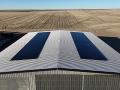
Future Visions' building inventory was not without size. It included a 100- x 200-foot fabric-covered Cover-All building, a Morton Buildings' 81- x 251-foot cold-storage building and a 72- x 195-foot building erected in 1998. But Vaughn and Vance were drawn to something larger when they learned Morton offered a building that combined its traditional post-frame construction with pre-engineered steel roof trusses. The Morton, Ill., builder calls it the Morton Hybrid Building. The open-webbed trusses give Morton the capability to build clear-span structures up to 150 feet wide. By August 2011, a 125-foot clear-span Morton Hybrid was rising on the Zacharias farm.
P[L1] D[0x0] M[300x250] OOP[F] ADUNIT[] T[]
"We built it for the future," Vance says. Growth will bring more equipment to this farm, and storage space has a direct value. Just storing the equipment out of the harsh North Dakota climate saves a 6 to 7% cost for depreciation caused by weathering, Vaughn adds.
NEVER TOO BIG
Son and father agree it's easy to build a shop too small. But it's the rare shop on a growing farm that is ever too large. The building has 20 feet of clearance at the doors. The center is 32 feet high. The inside area is physically divided into two spaces. The main shop space is 125 feet wide x 260 feet long. Outside, a 6-inch-thick concrete apron pushes 40 feet out from the door and down along the building for 240 feet.
The main shop is divided into three areas, but by use and not by walls. First, a maintenance area measures 105 feet x 125 feet. It features a 42-foot-wide PowerLift Hydraulic door on the front of the shop (south side) and a 32-foot PowerLift door on the back, the north side.
The second area, space to park trucks and equipment, is allotted 115 feet. It's accessed by two south-facing, 42-foot-wide hydraulic doors. Each door has two windows for natural lighting and enables the operator to see if any obstructions are in the way of an opening door.
The third area is 40 feet wide and is set aside for tools and parts. There are no fixed benches in this shop. Supplies, parts and tools are rolled out to the work performed in the shop. Electrical outlets are spaced every 15 feet around much of the shop.
On this day, the shop holds three Case IH Quadtrac tractors, five semitrucks (four with trailers), a Case IH self-propelled sprayer, two John Deere planters, a 54-row DB90 (20-inch spacing) and a 36-row DB60 (20-inch spacing), and two pickup trucks. In a far corner, looking pretty lonely, is a 571-hp, 6-cylinder, turbo-charged Case IH 9230 combine. Work flows around us. The remaining open space is, well, generously spacious.
AIR TO THE MIDDLE
An interesting idea in the shop is the placement of compressed air reels in two locations, both in the middle of the floor (see photo below). With access to under-the-floor compressed air, each unit's 100-foot hose delivers compressed air out over a circular area 200 feet in diameter. Their location eliminates the need to drag compressed air hoses from wall-mounted drops out to the middle of the shop. Also, both units can be removed when more obstruction-free space is needed.
"Our shop serves our expectations," Vaughn says. "Our facility is designed to shelter us from the elements so that we can work comfortably in an enclosed environment year-round. Our needs are met by our facility. We continue to make changes to the tools we have available within the facility."
The far west end of the building is an enclosed, drive-through wash bay, 40 feet wide and running the width of the building. The wash bay is accessed by two 28-foot-wide x 20-foot-tall hydraulic doors. Two banks of 8-foot fluorescent lights are mounted vertically along the walls of the bay. That configuration spreads light evenly across the equipment from 4 feet off the floor up to 12 feet. The water is softened and heated in a Hotsy industrial power washer (3,000 pounds per square inch, 6 gallons per minute). Compressed air outside the entrance allows drivers to blow loose debris off equipment before it enters the wash bay.
The wash bay saves the farm time and money. Before it was built, semi drivers drove the farm's trucks every two weeks to Fargo to get them cleaned. It cost fuel for the 140-mile round trip, driver time and the cleaning charge.
WARM AND TIGHT
Heating is divided into three zones and is supplied by two off-peak boilers that warm 7.1 miles of Pex tubing under the floor. Off-peak boilers operate on an off-peak electricity schedule offered by Vaughn's local electrical cooperative in exchange for a reduced electrical rate. The floors store enough heat to keep working conditions comfortable when the boilers are shut down by the co-op.
The building has 14 inches of insulation in the ceiling for an R-value of 50. The walls have an R-value of 30. Winter heating costs average $45 a day (keeping the shop at 60°F and the wash bay at 65°F). Vance says heat lost to open doors is minimized by opening doors only enough to allow a particular piece of equipment to move in or out. In the summer, the equipment to be used that day is moved out all at once early in the morning. The practice helps preserve the natural cooling offered by the floor.
Seventy-two ceiling-mounted fixtures light the main shop, each holding six highly efficient T5 fluorescent tubes. The lights provide floor-level illumination equal to average office space. The south wall includes a high bank of a half-dozen 4- x 5-foot windows that bring supplemental natural light into the shop. They also capture the warming light of the low-angle winter sun.
"We are very satisfied with the choices that we made relating to the construction of our shop," Vance says. Yet, he and Vaughn now see a couple of changes they could have made during construction.
One of those changes relates to the building's underground lines for compressed air, electricity and water. "We wish that we would have added more lines and sized our lines bigger to accommodate for changes to plans or designs," Vance says.
The Zachariases learned something about compressed air lines. "We also learned that it is best to have air lines in a circuit," Vance says. Circuits more capably equalize the air pressure at every air outlet. "[But] these are slight changes that will not affect our overall happiness relating to our project," he says.
(AG)
Copyright 2013 DTN/The Progressive Farmer. All rights reserved.