


Maryland Farmers Adapt to Input Costs
Precision Agriculture and Fertilizer Cuts Help Farmers Manage Margins
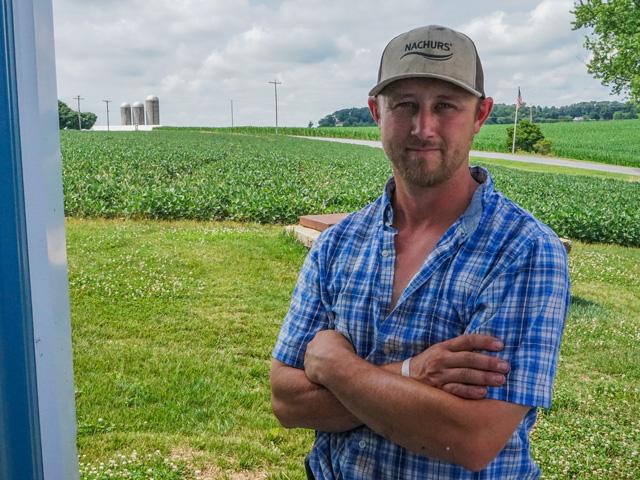
WESTMINSTER, Md. (DTN) -- Greg Dell has spent the past five years using precision agriculture to make one part of farming more efficient: fertilizer.
The Westminster, Maryland, farmer has used variable-rate technology to cut fertilizer applications in parts of his fields without sacrificing yields, giving him another tool to manage increasingly tight margins.
Dell and other East Coast farmers began adjusting fertility practices early, putting them into practice as part of longer-term strategies rooted in the Chesapeake Bay's environmental stewardship demands. But if disruptions around the Strait of Hormuz continue to constrain fertilizer supplies, the push for greater efficiency could become even more important.
Fertilizer prices have been mixed in the middle of August. DTN reported this week that prices for five fertilizers declined, led by UAN28, while DAP, MAP and potash prices were slightly higher than last month.
"Compared to three years ago, my average nitrogen use is down around 50 pounds an acre," Dell said. "We run variable-rate maps on whatever piece of equipment is going across the field."
Dell Brothers Inc. operates with Greg, his uncle, cousin, father and grandfather. The family develops its cost-per-acre estimates in February, helping guide marketing and input decisions before the growing season.
At the time those decisions were made, both nitrogen and phosphorus prices were higher, but Dell had purchased the fertilizer before the Strait of Hormuz closed and oil prices spiked.
DTN's fertilizer price analysis showed UAN solutions led the decline. UAN28 was 7% lower, with an average price of $446 per ton. Three fertilizers were slightly higher compared with last month. DAP had an average price of $917/ton, MAP $960/ton and potash $495/ton.
The Dells use variable-rate sidedress applications and nitrogen models that account for weather, soil type and crop history. The same approach helps the operation make more precise applications of other expensive but crucial nutrients, such as phosphorus.
The farm began planting variable-rate seed about six years ago before expanding the technology to fertilizer applications. Now, lime and most other field passes are also variable-rate using John Deere sprayers and New Leader spreaders with John Deere rate control.
"I think my average this year is like 140 pounds (per acre) of nitrogen across all of our dryland corn acres," Dell said. "That has made us more efficient and brought our cost of production down just doing that."
Variable-rate technology has been available for decades, but adoption has continued to grow as precision equipment has become more common. According to U.S. Department of Agriculture data, about 27% of U.S. farms reported using variable-rate technology to manage crops in 2023.
For larger operations, the cost of precision technology can be spread across more acres, said Ali Mirzakhani Nafchi, an assistant professor and South Dakota State University Extension precision agriculture specialist, in a report. Smaller farms can face higher per-acre costs, along with barriers involving data management, technical expertise and training.
P[L1] D[0x0] M[300x250] OOP[F] ADUNIT[] T[]
LONG-TERM FERTILIZER STRATEGY
The industry goal for fertilizer inputs is to increase domestic supply while relying on imports in the short term.
The latest potential improvement for phosphate supplies came as OCP Group's 54,000 metric tons of triple superphosphate, or TSP, fertilizer from Morocco arrived at the Port of New Orleans on Monday. While the additional phosphate supply is helpful, analysts point out that TSP is not as popular in the U.S. marketplace as MAP or DAP.
"This is immediate relief while we build the long-term solution," USDA Secretary Brooke Rollins said on social platform X on Tuesday.
For farmers such as Belinda Burrier, fertilizer supply and prices are part of a larger calculation. The Union Bridge, Maryland, farmer operates a no-till farm growing corn, soybeans and wheat, where fertilizer management is part of a longer-term approach to farm economics.
Belinda and her husband, David, saw fertilizer prices coming.
"We did cut back on aerial applications," she said.
Their goal is to use nitrogen as efficiently as possible, eventually reducing nitrogen applications to zero. That aligns with the farm's fiscal priorities while also addressing nutrient concerns in the Chesapeake Bay watershed.
But in the long term, Burrier said, the farm is willing to adopt new technology when it makes sense.
The farm uses drones for some top-dress applications. Last year, drones also applied a slug-control treatment in soybeans. The operation also uses variable-rate technology for fertilizer applications, although it does not variable-rate its seed.
They want to do the "right steps, with old equipment," she said.
Their decision to keep older equipment is practical: They are looking ahead to the next generation before making major new investments.
That approach has not stopped the Burriers from being thought leaders and advocates for other farmers, nor have fertilizer prices.
SOUTHERN SORGHUM, NORTHERN MARKET
For Dell, reducing fertilizer costs is only one part of managing risk.
The family operation also owns and operates a grain elevator, giving the farm another source of income while providing a service to nearby producers.
"It's a little bit of insurance, really, because it's income coming from other areas that's not just corn and beans," Dell said. "Running the elevator helps us maximize our own crop and work with our community more."
The farm also grows and stores sorghum, as do a few other farms in the region. Much of the crop is grown under contracts for birdseed markets. The crop moves north to facilities in Pennsylvania and Ohio, including markets for gluten-free flour.
Sorghum can be hedged on the same corn price, but its basis is more variable than corn. The crop also offers an agronomic advantage in parts of Maryland where deer pressure can make corn production more difficult.
"Tannins in sorghum plants are very high and deer do not like that. We use it in high-pressure deer areas rather than plant corn," he said.
Diversification, precision agriculture and long-term nutrient management give Maryland farmers additional tools to navigate tight margins.
The sorghum market, like fertilizer prices, Dell said, is "steady enough."
See USDA's 2023 Variable Rate Technology Report: https://www.ers.usda.gov/…
SDSU Report on Variable Rate Technology Adoption: https://extension.sdstate.edu/…
Read more at "5 Fertilizer Prices Slightly Lower Than Last Month; 3 Higher," https://www.dtnpf.com/…
Jake Zajkowski can be reached at jake.zajkowski@dtn.com
Follow him on social platform X @jzajkow
(c) Copyright 2026 DTN, LLC. All rights reserved.

