



Cash Market Moves
2026 Spring Wheat, Durum Harvest Mixed Bag of Yields and Quality
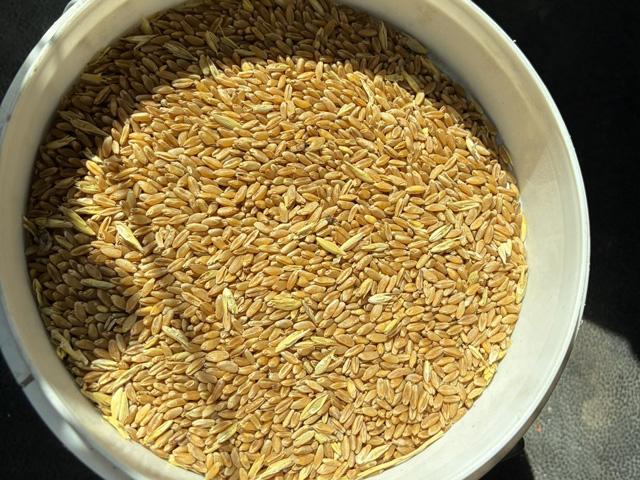
Farmers and elevator managers reported mixed results from the 2026 spring wheat and durum harvest, with outcomes shaped by weather from seeding through harvest. In many areas, protein was strong, while yields and test weights varied depending on how much rain fell and when the heat arrived.
In its Small Grains Annual Summary, USDA estimated 2026 other spring wheat production at 450 million bushels and durum production at 64.8 million bushels. The North Dakota Wheat Commission's annual crop-quality reports also showed lower production for both crops, with hard red spring wheat production down 10% and Northern durum production down 26%.
Here is what several farmers and elevator managers told me about the crop in their areas.
Austin Sundeen, east of Devils Lake, North Dakota, did not grow wheat on his farm this year but helped a neighbor with harvest.
"Test weight (TW), quality and yield were excellent and we kind of figured it be with the weather we were given," Sundeen said. "As much as the eastern side of North Dakota was going through severe drought, our little pocket seemed to catch just enough rain when we needed it. I think we learned a valuable lesson that we don't need 30 inches of rain to raise a great crop."
Sundeen also custom farmed 300 acres of durum for a retiring farmer and said the crop looked good throughout the growing season. Test weight came in at 60 pounds per bushel, color was excellent and the straw yield was good.
Cory Tryan, grain manager at Alton Grain Terminal LLC in Alton, North Dakota, said area spring wheat yielded around 50 bushels per acre, with good quality and higher-than-normal protein following heat and a lack of moisture during mid- to late summer.
Darrin Schmidt in eastern North Dakota saw a similar trade-off between yield and protein. He noted that harvest seemed to go fast due to lack of rain.
"All of our wheat was below APH (around 10%-30%), but in return, the protein was higher. We were running close to 15%, if not above, where normally we would be around 14%," Schmidt said. "Quality was good and no falling number issues. TW was a little lower than normal but still was good quality wheat."
Bart Swanson of Hoople, North Dakota, said his wheat was "pretty good," with protein ranging from the mid-13% to mid-14% range and good test weight.
In north-central North Dakota, Josh Backstrom said wheat yields were a little above average, while protein ranged from 12.5% to 13.5%. "We ran out of nitrogen again even after changing things up a bit and split applying N." Some wheat came off wet, requiring air drying or a trip through the dryer to beat incoming rain and retain quality.
Kim Saueressig of McClusky, North Dakota, also saw yields vary widely following a flash drought that began in early July.
"Poor ground was low yields and the better ground was better than average," Saueressig said. "All in all, I'd say durum and small grains were average, which is good, but compared to the last three to four years, it was a disappointment. Quality was fantastic this year. We took about a third off on the wetter side and ran it through the drier and was fortunate that the weather stayed dry."
Later durum that came off was dry with really good color, test weight, and protein and went straight into the bin, added Saueressig.
Near Minot, North Dakota, Jeremy Burkhart, CEO of United Quality Cooperative, said wheat harvest went OK despite a dry July and early August followed by rain around the start of small-grain harvest. "Luckily, 90% of the wheat in our area came off decent with around 10% lower falling number (FN) feed quality."
P[L1] D[0x0] M[300x250] OOP[F] ADUNIT[] T[]
Protein averaged in the 14% range, and Burkhart estimated wheat yields at 50 to 70 bushels per acre -- better than expected, considering the 95- to 100-degree weather they had for a three- to four-week stretch.
Durum was more variable.
"Durum quality was decent for the guys that got it off without too much rain, but there is some lower color due to rain," Burkhart said. "I call it 60% milling, 30% amber and 10% feed. Yields for durum didn't quite hold up in the heat as well as the wheat did."
He estimated durum yields at 40 to 50 bushels per acre and said quality and yields declined northwest of his trade area.
That was the case around Williston, North Dakota, where Bryan Larson said the growing season was difficult almost from the start.
Larson said they began seeding at the end of April in dry conditions, expecting rain in May that didn't come. Some durum had not sprouted nearly six weeks after planting. "Then on the 14th of May, a windstorm that looked like the dirty 30's hit and everything that was seeded, drifted and blew. Ditches were filled in spots."
June rain brought some hope, but hot and dry weather returned in July just as crops were flowering.
"The late durum was pushed, so it was ready when the early durum was. Empty heads, or small kernels. The protein was 17% to 18%, and TW was 56 to 59 lbs.," Larson said. "The early durum did lose color and quality. The later durum held color a little better with higher hard count. Yields were low- to mid-20-bushel-per-acre range."
"A very dismal year for us," Larson said.
Not everyone had trouble.
"Harvest was fast and furious this year," said Riley Schriefer in western North Dakota. "We had great conditions and a great wheat crop!"
Matthew Krueger of East Grand Forks, Minnesota, also had a good wheat crop. He reported protein around 15% and test weights of 59 to 61 pounds per bushel, while yields came in 6% above expectations.
"Later-seeded wheat had more negative impact due to drought than earlier seeded this year," Krueger said. "Straw was really good, and some guys were selling it off the field this fall. All in all, very happy with the crop."
In South Dakota, results depended heavily on rainfall.
Kevin Kjorsvik, general manager of Oahe Grain Corp. in Onida, told DTN on Aug. 7 that spring wheat yields ranged from 20 to 70 bushels per acre, with better yields to the south where more rain fell. Protein ranged from 12.5% to 17% and averaged 15%, while test weight averaged more than 59 pounds per bushel.
Ryan Wagner of Wagner Farms in Roslyn, South Dakota, said yields were slightly above average, with good quality and protein around 14%.
"I think the hot and dry spell in June and again during grain fill hurt us a little more than we thought at the time because relative to corn and soybean yields, wheat yields look a little disappointing now looking back," Wagner said. "We also had seven inches of rain just prior to harvest which probably cost us a little test weight but overall, it was an average crop with pretty good quality."
Farther west, Art Schultheis of Diamond-S Farms Inc. in Colton, Washington, said spring wheat in southeastern Washington produced below-average yields because of limited moisture from May through July.
His farm raised only soft white spring wheat for seed this year. It yielded 51 bushels per acre compared with a five-year average of 77 bushels, but test weight was good at 63 pounds per bushel.
Schultheis added, "Looking ahead to 2027, we had good moisture this fall, and with the MPCI guarantee at $8.15 for winter wheat vs. $7.64 for spring wheat, there were a lot of acres re-cropped back to winter wheat that would normally be planted to spring wheat. I expect low acres of spring wheat in our area next year."
2026 SPRING WHEAT AND DURUM QUALITY
The North Dakota Wheat Commission's annual crop-quality reports put some numbers behind what farmers and elevators saw this year. These reports are also important to flour millers, pasta makers and exporters.
The 2026 hard red spring wheat crop averaged No. 1 Northern Spring, consistent with recent years. Average test weight was 60.4 pounds per bushel, with drought stress particularly affecting western growing areas. Average protein was 14.7% on a 12% moisture basis. Seventy percent of the crop was 14% protein or higher.
For durum, 2026 production of the Northern crop was down 26%, driven by a 22% decline in planted acreage and slightly lower overall yields.
The crop averaged No. 1 Hard Amber Durum, although just under 40% of samples made that top grade. Average test weight was 60.5 pounds. Average vitreous kernel levels were 77%, and about 70% of the crop had vitreous levels of 75% or higher. Protein averaged 14.5% on a 12% moisture basis, above last year and the five-year average.
So, just as farmers and elevators reported, there really wasn't one story for the 2026 spring wheat and durum harvest. Some areas caught the rain at the right time and came away with good yields and quality, while others dealt with drought, heat or harvest rain that cut yields or hurt quality.
Now, as Saueressig put it, "we wait to see what the markets do."
The full crop-quality reports are available from the North Dakota Wheat Commission at https://www.ndwheat.com/….
Mary Kennedy can be reached at mary.kennedy@dtn.com
Follow her on social platform X @MaryCKenn
(c) Copyright 2026 DTN, LLC. All rights reserved.