

Mud Management for Feedyards Important
Proper Mud Management in Feedyards Valuable for Maintaining Cattle Performance
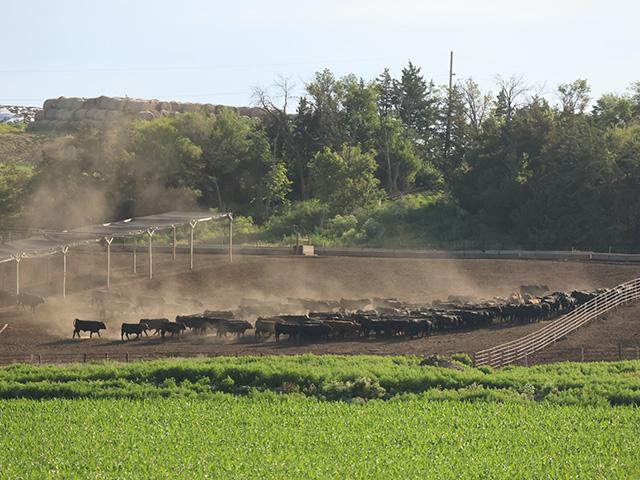
OMAHA (DTN) -- The near record rainfall that fell in the month of September in the High Plains region saturated soils. While good news for drought affected areas, the nearly constant rainfall in the month also caused muddy conditions in the region's feedyards.
Often the most valuable investments a feedyard can make are not found in the ration or processing barn. Facility improvements that enhance pen condition, cattle comfort and labor efficiency can have lasting effects on performance and costs of gain, according to experts.
MUD AFFECTS CATTLE PERFORMANCE
Mud affects how cattle act in the pens of the feedyard. In a report titled "Mud Management in the Feedlot" from Ohio State University (OSU), Stephen Boyles, OSU Extension beef specialist, wrote that mud reduces accessibility to feed bunks for cattle (https://u.osu.edu/…). The general effects of muddy lots include decreased feed intake, lower average daily gain and the requirement of more feed for each pound of gain.
As animals are stressed by mud, they eat less and their maintenance requirement increases. When combined, these two factors can cause a loss in animal performance and a corresponding increase in the cost to produce that animal.
Feed intake may become more variable, contributing to digestive upsets. This will further reduce animal performance.
The following table can be used for feedlot performance projections according to mud conditions:
| Lot Condition | Gain Reduction |
| No Mud | 0% |
| Dew claw deep | 7% |
| Shin deep | 14% |
| Below hock deep | 21% |
| Hock deep | 28% |
"Not only does it (muddy conditions) affect animal performance, but it can also affect feedlot owner behavior," Boyles wrote. "Some cattle feeders may be less inclined to purchase/add cattle to an already muddy feedlot."
DRAINAGE IN FEEDYARDS AN IMPORTANT CONSIDERATION
P[L1] D[0x0] M[300x250] OOP[F] ADUNIT[] T[]
Poor pen conditions can erode feed efficiency, increase maintenance requirements and drive-up cost of gain throughout the feeding period, according to recent report titled "Managing Mud in the Feedyard: Focusing on What Matters Most" written by Connor Biehler, University of Nebraska-Lincoln (UNL) Extension educator (https://water.unl.edu/…).
While the weather cannot be controlled, feedyard design and maintenance decisions can help minimize the impact of mud and protect profitability. The greatest returns often come from investments that improve conditions for the cattle.
Drainage in feedyards is an important consideration when trying to limit mud in the pens.
If water cannot leave the pen, other improvements can be made less effectively. Poor drainage leads to mud accumulation, which can reduce cattle comfort, increase energy for maintenance requirements and increased labor demands.
Producers should periodically evaluate the following questions:
-- Does water leave the pen quickly following a rainfall event?
-- Are there low spots where water consistently pools?
-- Are the drainage channels remaining open and functional?
-- Is runoff from roads, fields or neighboring pens entering cattle pens?
There are practical steps which can be done to improve drainage in feedyards. These include leveling pens to eliminate low areas, maintaining proper pen slope toward channels, cleaning ditches and drainage ways regularly.
In addition, diverting runoff from adjacent areas away from cattle pens, regularly removing manure accumulations that restrict water movement and repairing high-traffic areas where heavy cattle activity has altered drainage patterns are also important considerations.
Even feedyards with well-drained pens, cattle can benefit from having access to dry resting areas. Pen mounds provide cattle with elevated locations that remain drier than the surrounding pen surface during muddy times.
To maximize effectiveness, producers should maintain adequate mount height. This should generally be five feet tall.
The mound should have at least 25 square feet per head of mound space. Repair erosion and loss of shape over time and position mounds so water drains away from resting areas.
There are some signs producers need to watch for that indicate mounds may need maintenance. This includes flattened mound profiles, standing water near the base of the mound, excessive manure accumulation and cattle crowding onto a small portion of the mound.
"Effective mud management starts long before wet conditions develop," Biehler wrote. "The best strategy for managing mud is mitigating it before it becomes a problem."
Feedyards that prioritize drainage and maintain functional pen mounds are often better equipped to minimize mud, improve cattle comfort and protect performance during wet conditions.
Russ Quinn can be reached at Russ.Quinn@dtn.com
Follow him on social platform X @RussQuinnDTN
(c) Copyright 2026 DTN, LLC. All rights reserved.