



Marketing Timing Matters for Cull Cows
Body Condition and Timing Key to Cull Cow Marketing Profits
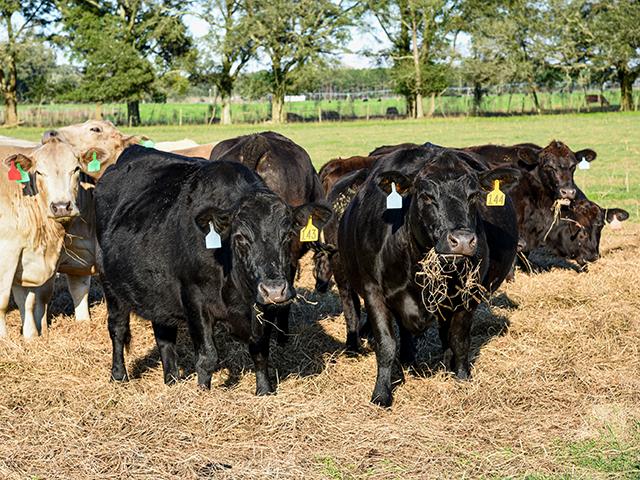
REDFIELD, Iowa (DTN) -- Cull beef cows account for about 10% of the U.S. beef supply and often generate 15% to 20% of the gross revenue for a typical cow-calf operation, according to Paul Beck, Oklahoma State University beef cattle nutrition specialist. Because of their contribution to annual income, how and when cull cows are marketed can have a significant impact on profitability.
Cull cows are priced according to live animal grades that reflect body condition, expected dressing percentage and lean meat yield. "Four primary carcass grades are used when sorting cows that are sent to market: Breaking Utility, Boning Utility, Lean and Lights or Canners," Beck explained.
Breaking Utility cows are generally the highest-valued animals, carrying body condition scores (BCS) of 7 or greater and dressing percentages of 52% to 55%. Beef cattle BCS ranges are from 1 to 9, with a score of 1 reflecting cows that are emaciated and a score of 9 being cows that are obese. Boning Utility cows typically have BCS of 5.5 to 6.5 and dress around 50%. Lean and Canner cows are thinner, have lower dressing percentages and receive substantial discounts.
"Current market premiums highlight the value of added condition," said Beck. "Breaking Utility cows commonly bring $3 to $5 per hundredweight more than Boning Utility cows and more than $10 per hundredweight above Lean and Canner cows."
Research done by Jason Apple and his colleagues at the University of Arkansas found that body condition is closely tied to carcass grade. Only about one-third of cows with a BCS of 3 graded as Boning or Breaking Utility, while 73% of BCS 6 cows and all BCS 7 cows achieved those higher-value grades. As a result, improving body condition before marketing can significantly increase both sale weight and price.
Using current cull cow prices, expected weight gains between body condition scores and anticipated grade improvements, Beck estimated that moving a cow from a BCS 3 to a BCS 7 could increase her market value by more than $450. Increasing condition from very thin BCS 2 cows to a BCS 8 could add nearly $700 in value through a combination of heavier weight and improved grading.
P[L1] D[0x0] M[300x250] OOP[F] ADUNIT[] T[]
"Despite those opportunities, many cull cows are marketed before reaching their full value potential," he said. "About 60% of cull beef cows are sold as Utility-grade animals, while 20% to 25% are marketed in the Cutter grade and 5% to 15% in the Canner category.
ADDING CONDITION CAN INCREASE VALUE
For producers considering adding condition before marketing, several feeding options are available.
Research from Texas Tech University demonstrated that thin cull cows with a BCS of 2 can gain weight rapidly in feedlot settings. A high- or low-roughage diet fed to cows over a 45-day feeding period showed gains between 5.8 and 6.4 pounds per day and improved by approximately three body condition scores. Those gains do require substantial feed intake, with cows consuming 30 to 32 pounds of dry matter daily.
Producers without feedlot facilities may be able to improve condition through grazing and supplementation programs. Recent research found that cull cows grazing pasture while receiving supplement at 0.5% of body weight gained about 126 pounds in 84 days. Increasing supplementation to 1% of body weight boosted gains to nearly 193 pounds over the same period.
MANY FACTORS AFFECT PROFITS
Beck said whether retaining cull cows is profitable depends on more than just increased sale value. Feed costs, forage availability, labor requirements, animal health, interest expense and market risk all affect the final outcome.
Feeding a total mixed ration in a drylot can be an efficient way to add weight and condition, but it requires facilities, equipment and management that may not be available on every operation. Grazing programs are often easier to implement but may produce slower gains and can become costly when forage supplies are limited.
In some regions, recent moisture has improved wheat pasture conditions, creating another option for adding value to thin cows.
"Strong calf prices have also made some cow-grazing programs competitive with traditional stocker enterprises. Cows can gain rapidly on wheat pasture, though they generally require heavier stocking rates than growing calves," he added.
The key management decision is determining whether the added value from improved condition outweighs the cost and risk of retaining the animal. For thin cull cows, especially those entering the market at BCS 3 or below, adding weight and condition before sale can substantially increase returns, but careful budgeting is essential to ensure higher revenue translates into higher profit.
Jennifer Carrico can be reached at jennifer.carrico@dtn.com
Follow her on social platform X @JennCattleGal
(c) Copyright 2026 DTN, LLC. All rights reserved.

