


Plains, South Pastures Lag Well Behind
Drought Pushes Plains, Southwest Pasture Conditions Far Below Year-Ago Levels
REDFIELD, Iowa (DTN) -- Drought is hammering pastures and rangeland across the Plains and Southwest, pushing conditions significantly below where they stood a year ago.
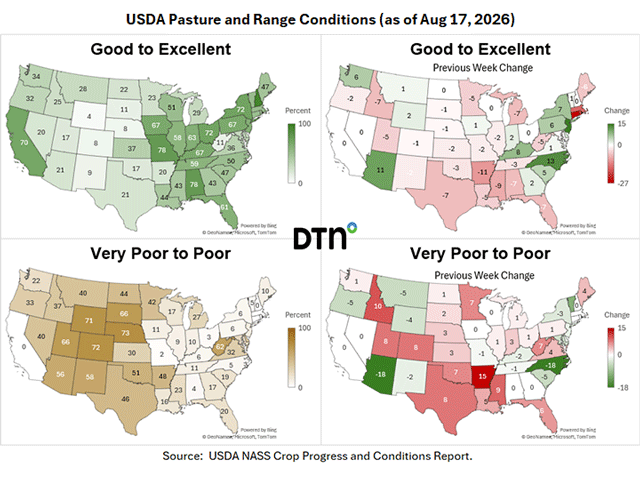
The states with the highest percentage of pasture and range in the very-poor-to-poor category are in those two regions, according to USDA's weekly Crop Progress report released on Monday. Nebraska, Colorado and Wyoming have the highest percentage of pastures in this category at 73%, 72% and 71%, respectively. These states also lack pasture in the good-to-excellent category, with Nebraska and Colorado both at 8% and Wyoming at 4%.
DTN Ag Meteorologist John Baranick said the stagnant weather pattern last week led to multiple rounds of showers and thunderstorms in some of the bigger cattle areas from Montana down to Colorado and into the Dakotas down through western Kansas.
"That should have helped to improve conditions; if not right away, then this week and beyond, as forages might start to green up a little better now. Some follow-up rains should be noted this week as a few disturbances go through these same areas. Not a lot of organized, heavy rain like we saw last week, but something is better than nothing," he said.
P[L1] D[0x0] M[300x250] OOP[F] ADUNIT[] T[]
The Midwestern states of Iowa and Missouri continue to be in good shape for moisture, which is reflected in pasture conditions. Iowa is at 67% of pasture and range in the good-to-excellent category, which is a 1-percentage-point increase over last week. Missouri has 78% of pasture and range in the good-to-excellent category, even with a 2-point decrease since last week.
Baranick said the heavy rain that moved through Iowa and continued eastward to Ohio led to some areas dealing with flooding. "If they aren't, their pastures and ranges should see marked improvements after some drier conditions," he added. "That didn't continue farther south, though. A couple of fronts will move through the Midwest this week, and that should bring through some scattered rains. For some areas that were drier last week, like Minnesota and Wisconsin, they should benefit. But those wet areas don't need to see any more rain, and that could hurt."
Drought conditions are spreading across the South, with increased D3 (Extreme Drought) and D4 (Exceptional Drought) seen in parts of New Mexico, Texas and Oklahoma. This has also led to declining pasture and range conditions in those states. New Mexico has 58% in the very poor-to-poor category, with only 9% rated as good to excellent. Texas has 46% poor-to-very-poor conditions and 21% rated good to excellent. Oklahoma has 51% of pastures and range in the very poor-to-poor category, while 17% is in the good-to-excellent category. Kansas remains in the middle with 37% of pasture and range in good-to-excellent condition and 30% reported as very poor to poor.
Baranick said that across eastern Kansas through southern Illinois and down to the Gulf, it was not only very dry, but increasingly hot.
"Many days up near or over the century mark were noted with little rain or even cloud cover. Rapidly decreasing soil moisture is leading to flash drought conditions in these areas that should be noted well ahead of any updates to the U.S. Drought Monitor later this week," he said.
"A couple of fronts are expected to pass through this week. They won't be bringing down temperatures very much in the Southern Plains, if at all, and only marginally across the Southeast. Showers are forecast to be pretty spotty with these fronts, so no significant improvements to pastures or ranges are expected," Baranick said.
Nationwide, pasture conditions are much worse currently than they were a year ago. The very poor and poor conditions are currently at 22% and 26%, respectively, as compared to 11% and 20% in 2025. That is also seen in the good-to-excellent category, with current conditions at 20% good and 3% excellent, while a year ago those numbers were 29% and 10%.
| Very poor | Poor | Fair | Good | Excellent | |
| 48 States | 22 | 26 | 29 | 20 | 3 |
| Previous week | 22 | 25 | 28 | 22 | 3 |
| Previous year | 11 | 20 | 30 | 29 | 10 |
Jennifer Carrico can be reached at jennifer.carrico@dtn.com
Follow her on social platform X @JennCattleGal
(c) Copyright 2026 DTN, LLC. All rights reserved.