


Ag Weather Forum
First Atlantic Tropical System May Develop; Will Bring Heavy Rain to Gulf Coast Regardless
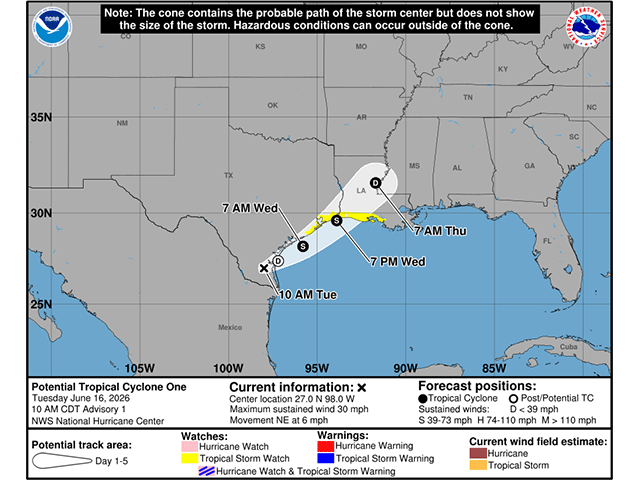
El Nino is a hot topic in the weather world -- and for good reason. It produces global weather impacts, which in some cases are positive and in others are negative. One impact is generally to reduce the number of tropical storms and hurricanes in the Atlantic Basin. But even if the numbers are reduced, tropical storms can and will still happen. The National Hurricane Center (NHC) is focused on one potential system in the Gulf of Mexico (Gulf of America) that could end up being named over the next day or two. NHC forecasters have already declared it a potential tropical cyclone on their website.
A disturbance moved into the Bay of Campeche on the southern end of the Gulf this past weekend. It did not become named and moved into northeastern Mexico where it sat on Sunday and Monday, June 14-15. However, that little low is making a move northward into south Texas, running into a lingering front along the northern coast of the Gulf, which may push it a bit offshore for Tuesday night and Wednesday, June 16-17. Spending time over the warm waters of the Gulf may lead to intensification, at least enough to classify it as a tropical depression or storm before it moves into Louisiana Wednesday night. From there, the low is forecast to move east-northeast through the Southeast U.S. for Thursday and Friday, June 18-19. NHC predicts it will become a weak tropical storm before reaching the Louisiana coastline late Wednesday.
P[L1] D[0x0] M[300x250] OOP[F] ADUNIT[] T[]
The storm will not spend enough time over the Gulf to become a strong tropical storm. But even a weak tropical storm or depression could still bring significant impacts to the Gulf Coast states, mostly in the form of heavy rain. The lingering front has already produced some heavy rain near the coast over the last couple of days. The stationary nature should continue heavy rain in the region throughout the week. Add onto that the potential tropical downpours that come with a named system, and intense flooding could be a problem.
Models are producing some incredibly heavy rainfall amounts near the track of the low, regardless of its classification. Including the rainfall from the front, amounts of 4-6 inches are looking likely from the Texas coast through Louisiana into southern Mississippi and Alabama. As the system continues through the Southeast, it will lose some of its intensity with amounts of 2-4 inches being more likely across Georgia and 1-2 inches in the Carolinas. The intensity will be variable and could exceed these ranges in some locations, especially in Louisiana and southern Mississippi. Like all landfalling tropical systems, the rain could be quite intense in these areas and may exceed 10 inches through the end of the week.
Given the recent heavy rainfall in the region that has significantly reduced drought, this rainfall would be a major concern for flooding. The National Weather Service already has flash flood watches out along the Texas coast into southern Mississippi. Heavy rain already has produced some flooding problems in these areas. The watches will likely be expanded eastward later this week regardless of whether the storm becomes named or not.
If this system does become strong enough to be given a name, it will become Arthur, the first of the 2026 Atlantic hurricane season. With the strong correlation of El Nino and a reduction in the number of Atlantic hurricanes, DTN's current forecast for the season is calling for 13 named systems and five hurricanes, below the average of 14.4 named systems and 7.2 hurricanes. Our forecasters are noting that an update to this forecast could trend those numbers lower this month, as waters in the tropical Atlantic are cooler than normal and this particularly strong El Nino is already causing issues with tropical storm development in parts of the Caribbean and tropical Atlantic.
To stay up to date with weather conditions and your local forecast for free from DTN, head over to https://www.dtnpf.com/…
John Baranick can be reached at john.baranick@dtn.com
(c) Copyright 2026 DTN, LLC. All rights reserved.