


Weather Extremes Can Put Calves at Risk
Extreme Temperature Swings Stress Young Calves and Threaten Producer Profits
REDFIELD, Iowa (DTN) -- Weather extremes across much of cow-calf country means producers need to check calf health more closely, looking for sickness.
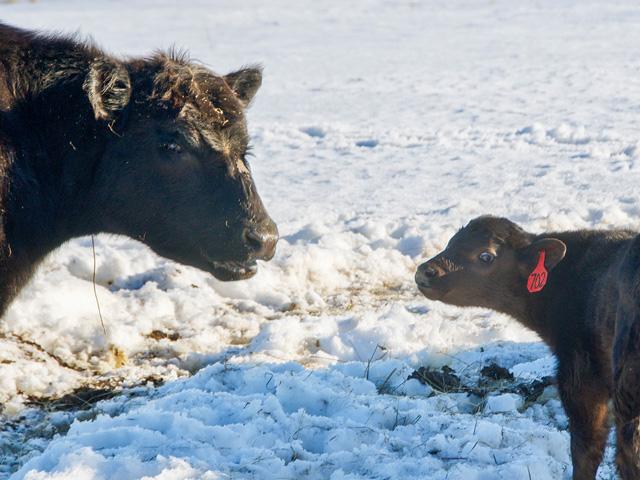
"After the extremely cold temperatures across Oklahoma a few weeks ago, we are now seeing daytime highs of 70 degrees Fahrenheit," said Oklahoma State University Extension Beef Cattle Breeding Specialist Mark Johnson. "It is important to remember that the calves born in single-digit temperatures need to be monitored closely as the weather becomes dramatically warmer."
The most comfortable range for young calves is between 55 and 70 degrees F to ensure a calf can maintain its body temperature without expending extra energy. Heat or cold stress can result in direct economic loss because of an increase in calf mortality and morbidity, according to Johnson. Indirect losses can be seen in reduced weight gain, performance and long-term survival.
CALF IMMUNITY IMPORTANT PREVENTION MEASURE
Calf immunity is an important part in preventing sickness and disease after birth. Jody Wade, senior professional services veterinarian for cattle with Boehringer Ingelheim Animal Health, said calf immunity and immunity through colostrum actually starts with the cow herd vaccinations.
"If we have the cows vaccinated so we know they are building good colostral immunity prior to birth, and then we know that colostrum is passed, so we get good passive immunity to those calves," he said. "This plays a huge role in how those calves continue to perform throughout their feeding cycle."
P[L1] D[0x0] M[300x250] OOP[F] ADUNIT[] T[]
Wade said the calves that appear to not have received adequate colostrum as a baby need to be vaccinated earlier than other animals that did get good colostrum because their antibody protection levels are lower. Ensuring the calves receive proper colostrum at birth can especially help prevent respiratory disease.
"If cows are vaccinated at pregnancy check time, they will build that immunity for the calf," Wade added. "It's just a game and if you play the game right, you get really good active immunity."
Johnson said the first signs of sickness is lack of nursing, a temperature different than the normal rectal temperature of 102.5 degrees F, and erratic or extreme behavior.
WEATHER STRESS STILL CAUSES HEALTH PRESSURE
Even with a good start to life, extreme temperature variations can cause stress and sickness in calves. "Heat stress is actually harder on young calves than cold stress," Johnson said. "When calves are heat stressed, they lose appetite, eat less, and are quicker to become dehydrated. Thermoregulation in calves is similar to that of adult cattle, but newborn calves have an immature thermostat and accordingly have more problems regulating body temperature during weather extremes."
He said cattle are able to adjust to adverse climate by means of acclimatization and adaptation. The extreme changes are harder to compensate for and result in thermic stress.
DTN Ag Meteorologist John Baranick said the last week of weather has been good for much of the country. However, two storm systems moving across northern areas have and will lead to widespread precipitation, including some heavy snow, mostly from Montana through Michigan and less from Nebraska through the Ohio Valley.
"Drier conditions will be noted farther south across the Plains, which has been concerning of late," he added. "Though the weather pattern has been extremely active. Western Kansas down to western Texas and back to the Rockies has been very dry."
A burst of colder air is expected through the country east of the Rockies following a weekend storm, but extreme warm temperatures will move into the Plains by early next week, some seeing record temperatures. Baranick expects the warmer air to spread through the Midwest by the end of next week. A more active weather pattern is expected toward the end of March, again targeting the norther tier of the country. Dryness is expected to continue in the southwestern Plains into April.
"As the weather becomes more pleasant and daytime highs exceed 70 degrees F, keep an eye on your young calves soaking up the sun," Johnson concluded. "The signs of overheating may not be as dramatic as the signs of cold stress but can be just as damaging to a calf's health."
See more on DTN's weather forecast at "Two Strong Winter Storms Producing Wind, Heavy Snow, Blizzard Conditions Through the Weekend," https://www.dtnpf.com/…
Jennifer Carrico can be reached at jennifer.carrico@dtn.com
Follow her on social platform X @JennCattleGal
(c) Copyright 2026 DTN, LLC. All rights reserved.