


Canada Markets
Energy Price Spike Stokes 1970s-Style Inflation Fears
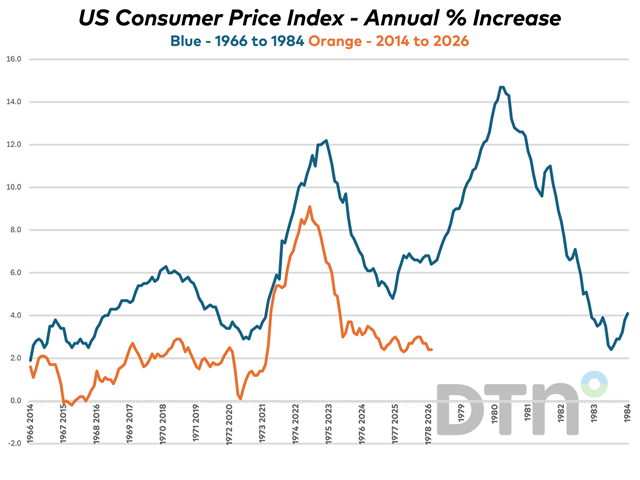
Everyone is impacted by inflation, like it or not. And likely everyone is impacted by increased interest rates -- either through higher borrowing costs or added income. As such, looking at the accompanying chart comparing the 1970s-inflation cycle to the current one, the similarities immediately should demand our attention. Especially considering the crushing interest rates that were required to bring the earlier cycle under control and the serious ramifications that resulted.
The two most important points that jump out are how the past few years have lulled everyone into a sense of calm that the worst is over, very similar to that experienced in the mid-1970s. With that being followed by a much more problematic spike in the late 1970s thanks to a similar conflict with Iran and confrontation over the Strait of Hormuz in the wake of the Iranian Revolution.
The spike in interest rates exceeding 20% by 1981 did manage to crush inflation as intended as seen at the tail end of the accompanying chart. It also crushed many businesses and farming operations along the way. A fact that should keep this topic front and center of management considerations for the next few years to come. It's worth noting it took about two years to play out from this point in the late 1970s.
Although it's been pushed to the back burner amid the current Middle East conflict, President Trump's fixation on lowering interest rates may play a serious role in how this unfolds. The sense of calm and triumph that the past few years of low CPI readings instills allows focus to be placed on reducing borrowing costs by lowering interest rates. But at a time when inflation is anything but under control, minimizing its importance can eventually allow it to run unchecked and accelerate higher. This area will need to be monitored closely in the future.
P[L1] D[0x0] M[300x250] OOP[F] ADUNIT[] T[]
Taking center stage currently is the price spike brought on by the conflict in the Middle East, its impact on energy supplies, and how it could inspire a surge in inflation like that seen at the end of the 1970s. Crude oil rallied to almost $120/barrel on March 8 in response to an escalation over the previous weekend. That was followed by a dramatic decline below $77/barrel (briefly) by March 10 amid conflicting reports on progress and potential duration of the war and its impact. Not to mention differing opinions of who was in control of the Strait of Hormuz and the resulting flow of traffic through it; that is currently at a standstill for all practical purposes.
To address the emergency, the International Energy Agency (IEA) and its 32 member countries agreed Wednesday morning to release a record 400 million barrels from their respective reserves. That far exceeds the previous record release of 182 million barrels during the Russian invasion of Ukraine. It's worth noting it had little impact on prices when announced and markets actually increased following the confirmation. The concern may be that releasing a third of the remaining reserves (currently estimated to be 1.2 billion barrels) when the price is only $86/barrel while Iran is threatening to continue with its chokehold until crude oil hits $200/barrel -- may be wasting precious supplies. The lack of a setback in price on the news will likely embolden those expecting a price rise and feed into the momentum higher.
Considering the role that an energy price spike may play in the coming months -- if not years -- a brief history review may be time well wasted. In the U.S., the strategic petroleum reserve (SPR) was established in 1977 to provide a supply cushion in case of emergency (such as the one we are currently experiencing). Inventory peaked in December 2009 at 726 million barrels. Various administrations began drawing it down to fight inflation (with many viewing it as being politically motivated) with the most serious drawdown seen following the Russian invasion in Ukraine and related crude oil price spike to $130/barrel. Inventories bottomed out in mid-2023 at a low of 347 million barrels. Both administrations have slowly worked at rebuilding it since, to its last reported level of 415 million barrels (as of Feb. 27).
With the relatively low level remaining in the SPR and the just announced plan to tap into it, there will be added pressure to resolve the conflict in the Middle East as soon as possible and get the Strait of Hormuz open. Anything short of that could result in new record prices being set, with a jump in inflation surely to follow.
So, what does that mean for management and marketing decisions? Refreshing your 1970s history lesson would be a good start. Being aware of the potential for increased prices when developing marketing plans and being on the lookout for triggers. It may also be wise to keep an open mind about prices increasing far more than expected and for no apparent reason as outside investors buy commodities as a hedge against inflation (more on that another day). And, unfortunately, considering the impact higher interest rates may have on an operation should a repeat of that part of the cycle be seen, prepare strategies on how to mitigate the impact.
I welcome feedback along with any suggestions for future blogs. My daily comments can be found in Plains, Prairies Opening Comments and Plains, Prairies Quick Takes on DTN products.
Mitch Miller can be reached at mitchmiller.dtn@gmail.com
Follow him on social platform X @mgreymiller
(c) Copyright 2026 DTN, LLC. All rights reserved.