


Spray Drones Offer Solid ROI With Better Application Timing, Improving Autonomous Workflows
Aerial Agronomics
There was a time not long ago when having a drone on the farm was a novelty. The same was once said about tractors, as well.
Whereas it took more than a half-century before most farmers put their horses and mules out to pasture in favor of tractors, agricultural spray drone adoption is moving at light speed.
"Farmers and the ag industry are taking this technology seriously. It's not a 'toy' anymore," says Taylor Moreland, founder and CEO of Missouri-based Agri Spray Drones. "In the next five to 10 years, the majority of farmers will have their own drones on the farm. Within five years, we'll see the technology and the regulations come together, and actually enable completely autonomous operation with drones to where you don't even need to have to be at the field."
This adoption is driven by a singular reality: Drones allow farmers to do their jobs better.
"What's a farmer's end goal? It's to produce the most crop with the least amount of inputs," Moreland says. "Farmers have seen that this technology is proven, and they want to spray when, where and how they want without relying on someone else. Custom applicators get paid by the acre, not by the outcome."
BEST ZONES FOR DRONES
While Moreland sells and services spray drones and accessories, he acknowledges they aren't always the best tool for applying crop-protection products. However, there are situations when using drones makes more agronomic sense and delivers improved return on investment.
"Drones need to be thought of less as a replacement for ground rigs and more so as doing what air applicators like helicopters and airplanes do, which is low-volume applications, typically 2-gallon (per acre) rates," he explains. "In other scenarios with higher volumes, if you can get it done with a ground rig, that's probably the way to do it."
Fungicides, insecticides, biologicals and foliar fertilization products are all good candidates for drone application for several reasons. The first is timeliness.
"What are you potentially losing in yield potential by not applying certain products when you should be applying them because you're waiting for the crop duster or it's too wet for a ground rig to roll?" Moreland asks. "The drone allows you to apply at the optimal time."
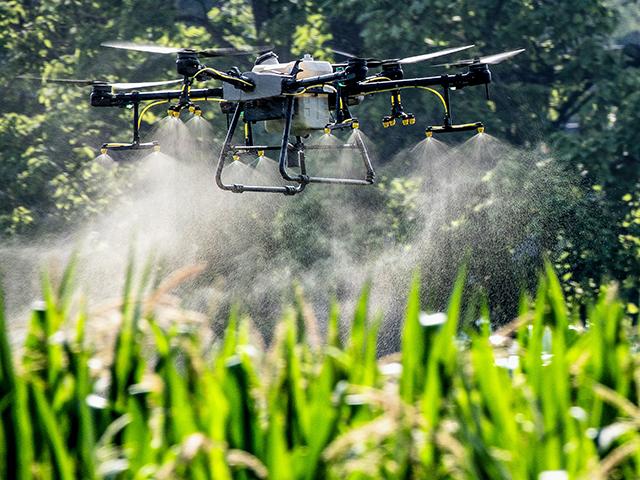
Canopy penetration is also improved thanks to the drone's rotor downwash -- the powerful, downward-moving, swirling column of air generated as the rotors spin.
P[L1] D[0x0] M[300x250] OOP[F] ADUNIT[] T[]
"If you can blow fungicide through 10-foot-tall corn down to the ear leaf, you're going to have better control of disease," Moreland says. "The spray penetration will even cover the underside of leaves, and you're not tearing up the crop in the process by driving through it."
While research from the University of Missouri found that ground-based sprayers demonstrated superior herbicide spray coverage, uniformity and less off-target movement than a drone, there are scenarios where drones can excel in controlling weeds. Spot-spraying herbicides is one example. A survey drone can scan a field and make a map of weedy locations, which is then loaded into the spray drone.
"It then knows where it needs to go and can move laterally across the field. The drone doesn't have to go up and down the rows," Moreland explains, noting that a similar strategy can be employed to address nutrient-deficient spots in a field or to only apply insecticide at field borders to protect against advancing pests. "This saves time, and again, you're not running over the crop with a ground rig."
Thanks to their narrow swath width, drones also are well-suited for conducting on-farm product field trials.
The cost of spray drones also makes them attractive. Today's most popular models cost only a fraction of what farmers would pay for a traditional sprayer.
CAVEATS TO CONSIDER
Despite these advantages, there are some considerations to address when incorporating a spray drone into a farm's operations.
Training, licensing and insurance are all mandatory. The Federal Aviation Administration requires that anyone operating a drone obtains both a Part 107 Remote Pilot Certificate and a Part 137 Agricultural Aircraft Operator Certificate. A 44807 exemption is also necessary because these drones weigh more than 55 pounds. A commercial pesticide applicator license is also required, along with liability insurance.
Moreland says farmers need to consider the time commitment, not just in training and licensing, but also in what it means overall for farming operations.
"If you're bringing a drone onto the farm, you're typically not replacing something you've done before," he says. "Instead, you're now doing something you used to call somebody to do," and that usually happens in the thick of summer, when farmers take vacation or are busy with the county fair.
ADDING AERIAL
Last summer, Tyler Ediger, of Meade, Kansas, decided it was time to add a drone to his family's farming operation.
"We wanted to be ready for what's next, because I don't think they're going away," he says.
It didn't take long for the drone to prove its worth. A wet August in southwest Kansas idled the Edigers' ground rig just as it was time to desiccate their sorghum crop.
"We didn't want to compact the ground, so we decided to use the drone," he recalls. "We actually sprayed an entire section (640 acres) with it, 28 feet at a time."
Ediger says that in the past year, they've employed the drone for both fungicide and herbicide applications. They've also started using it for their on-farm trials.
"Being timely with applications is really nice," he explains. "For herbicide application, you can catch weeds right after a rain when they're most vulnerable. And, you can also fly at night or early morning when you'll get better plant intake than you would with an airplane in the afternoon."
He says learning the routine necessary for drone spraying is almost like a dance. It takes time to master the steps, but with practice, it eventually clicks.
"The other reason for the drones is the next generation," says Ediger, whose sons, Jackson and Carter, are 14 and 11 years old, respectively. "Drones are the future, and so are they."
**
-- Follow Jason on social platform X @JasonJenkinsDTN
[PF_061026]
(c) Copyright 2026 DTN, LLC. All rights reserved.