

The Midterms and Iowa's Farm Future
In Iowa's Governor's Race, Farmers Look Beyond Party Lines
WASHINGTON (DTN) -- A wave of change could be coming to Iowa, at least in the way some farmers and rural residents cast their ballots.
The state's elections are drawing renewed attention to issues farmers say have long concerned them: agribusiness consolidation, a struggling farm input economy and water quality.
Iowa has long played an outsized role in national politics, from its presidential caucuses to its influence within the Republican Party. Now, the gubernatorial race is testing whether agricultural concerns can move voters across traditional party lines.
For Josh Rossell, 26, who farms with his grandfather near Atlantic, Iowa, those concerns have become a reason to reconsider the candidates he supports.
"No amount of grants, no amount of money to fix the facades on Main Street are ever going to do anything unless this agriculture economy is de-Earl Butz-ed," he said, referring to ousting Agriculture Secretary Earl Butz in 1976, who famously told farmers to "get big or get out."
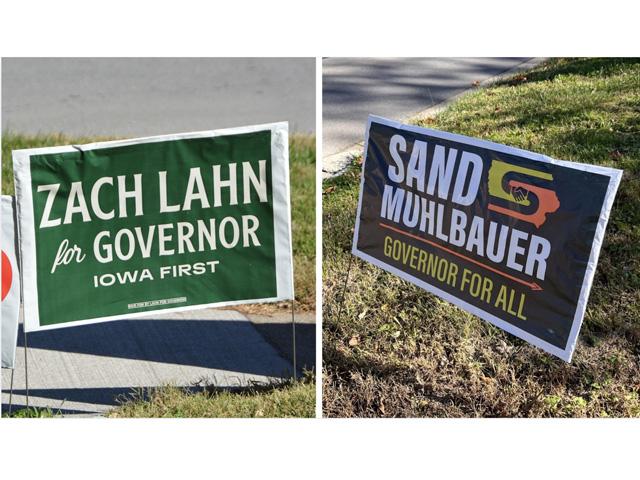
Traditionally a progressive voter, Rossell is instead leaning toward Republican gubernatorial nominee Zach Lahn.
"The reason that I trust him is because the depth of his knowledge and the way he's talking about it feels so familiar to people, I've only ever met within these agriculture circles," he said.
Lahn, 40, has built his campaign around challenging traditional Republican orthodoxy. His proposals include agricultural product safety testing, cancer research, improved water quality and efforts to challenge agricultural monopolies through antitrust enforcement. His message has attracted voters interested in the Make America Healthy Again (MAHA) movement.
Democratic nominee Rob Sand, 44, has also sought to appeal beyond his party, emphasizing government accountability, farm income diversification, raising the minimum wage and state income tax credits for conservation practices in farm fields.
"I think if we're looking at races where you're going to see a candidate outperform the kind of national party, Sand is going to be one who puts up one of those highest over performances because that is what he has done in the past," said Erin Convey, a House analyst for the Cook Political Report.
As of Oct. 19, the Cook Political Report rated Iowa's 2026 gubernatorial race as lean Democratic. YouGov polling showed Sand leading by 6 percentage points, while Marist University polling put his lead at 7 points. CNN/SSRS polling showed him ahead by 9 points in the first week of October.
For Kelly Nieuwenhuis, a corn and soybean farmer from Primghar, Iowa, dissatisfaction with federal policy hits close to home. This season, his two brothers shut down their grain-hauling trucking business, citing high diesel fuel costs that surged this summer during war in Iran.
A longtime Republican, Nieuwenhuis still plans to vote for Republican candidates in federal races. He calls Iowa's congressional delegation "champions for Iowa Agriculture and biofuels."
But after Randy Feenstra failed to win the Republican primary, Nieuwenhuis plans to vote for Sand in the governor's race. The Republican primary left the party and affiliated organizations without a unified candidate to support, Nieuwenhuis too.
"I appreciate his willingness to learn and understand," Nieuwenhuis told DTN about Sand. "He told me four years ago he knows how agriculture goes, how Iowa goes. And the reason we're about dead last in economic growth is because agriculture is struggling."
According to IBISWorld, Iowa ranks 50th in gross domestic product growth, with just 0.9% growth over the past five years.
P[L1] D[0x0] M[300x250] OOP[F] ADUNIT[] T[]
Sand, who has served as Iowa's state auditor for eight years, has built his political reputation on government accountability, including investigations into fraud and public corruption.
CONFUSING SIGNALS
Both candidates offer different approaches to Iowa's future, but they share some common ground on environmental issues and the state's traditional row-crop production system.
"There's just not a lot of daylight between the two candidates," said Monte Shaw, executive director of the Iowa Renewable Fuels Association. "I think for a neutral observer, if I gave you those two candidate questionnaire responses and didn't have a name on them, you know, might have a hard time saying which is which."
If voters are uncertain, their farm organizations are, too. The Iowa Farm Bureau PAC and the Iowa Association of Business and Industry did not endorse a candidate in the race.
The Iowa Renewable Fuels Association generally avoids endorsing candidates in open-seat races unless they present clear differences in biofuel policy. That is true this year, too -- both candidates have supported the future biofuels in the state.
Shaw compared this year's race to the 2006 gubernatorial election, when Democrat Chet Culver defeated Republican Jim Nussle, 54% to 44%.
Shaw said low-turnout primaries can produce candidates who fall outside Iowa's political mainstream. He pointed to the secretary of agriculture race, where Democrat Chris Jones advocates major changes to Iowa's corn and soybean system and stronger water-quality regulations, while Republican incumbent Mike Naig defends the state's established, ethanol-centered agricultural model.
War is another parallel. Disapproval of the Iraq War hurt Republicans in Iowa in 2006. Twenty years later, conflict with Iran and shipping disruptions are raising concerns about fuel costs.
On Monday night, President Donald Trump announced $8 billion in fuel relief due to that conflict.
A REFERENDUM ON FARMING, LED BY FARMERS
Agriculture is both an economic reality for many rural voters, and the candidates themselves.
Lahn grew up in Sioux City, where his father spent decades working in Iowa agriculture. After working as a political operative and running a private school in Kansas, Lahn returned to Iowa and became a farmer. He now owns a regenerative farm in Belle Plaine on land his family sold in 2005.
His running mate, Derek Wulf, is a fourth-generation farmer and rancher who serves in the Iowa House of Representatives and chairs the House Agriculture Committee.
Democratic candidate Sand is married to Christine Lauridsen Sand, CEO of The Lauridsen Group, a multimillion-dollar agriculture and nutrition company based in Ankeny. Democratic lieutenant governor candidate Dave Muhlbauer is a western Iowa farmer and county supervisor.
The candidates have also faced regulations and the financial hardships faced by their farmer constituents.
Iowa Department of Natural Resources records show the agency investigated complaints and issued notices of violation involving the Muhlbauer operation in 2009, 2014 and 2015 over manure management and feedlot runoff, the Des Moines Register reported. Wulf also has faced scrutiny over financial and legal issues involving his family farm, Shallow Creek Land & Livestock, in Black Hawk County. KCCI-TV reported that court records document disputes over unpaid loans and foreclosure proceedings.
But for Rossell, the central question is whether agriculture needs fundamental changes to remain sustainable.
His family farms corn and soybeans acres using cover crops, a handful of acres in the Conservation Reserve Program (CRP) and has practiced no-till for almost a decade. A trained ecologist who owns a prairie restoration business, Rossell offers services to landowners around the state and soon as technical service provider for the U.S. Department of Agriculture.
He supports elements of Sand's proposals for conservation incentives, edge-of-field practices and cancer research, but questions whether they address deeper problems. He believes Lahn has confronted those issues more directly, including pesticide regulation and antitrust enforcement against large agricultural companies.
"He (Lahn) has a genuine curiosity and excitement about the natural world that I think ... you just don't find generally in a politician, especially a Republican," Rossell said.
A CONVERSATION THAT LASTS BEYOND ELECTION DAY
While state lawmakers cannot control global conflicts or many farm input costs, they can influence pesticide regulations, antitrust enforcement and water quality incentives.
"I think more state leaders are beginning to recognize that the status quo is not delivering the return on investment that Iowa farmers, taxpayers, and communities deserve," said Tommy Hexter, executive director of the Iowa Food System Coalition. "The cat is out of the bag. I expect these issues to remain part of Iowa politics for a long time because they are fundamental questions about what kind of agricultural economy and rural communities we want to build."
Nieuwenhuis agreed that water quality and agricultural consolidation would remain part of the debate.
"Water quality is not going away. As farmers, we watch consolidation happen over the last 40-50 years, don't think any of those things are going away after the midterms. I think they're going to stay in the conversation."
Whether the election changes how farmers vote or simply make producers more willing to question party lines, the debate over agriculture's future is likely to continue.
"Sometimes the best choice isn't the party you're registered with," Nieuwenhuis said.
Iowa's GDP Growth Data: https://www.ibisworld.com/…
See Zach Lahn's platform: https://zachlahn.com/…
See Rob Sand's platform: https://robsand.com/…
Jake Zajkowski can be reached at jake.zajkowski@dtn.com
Follow him on social platform X @jzajkow
(c) Copyright 2026 DTN, LLC. All rights reserved.